Blog category:

The consequences of a bad hire can be manifold, and it can be distressing for a team and devastating for a business. This is what makes pre-employment assessments so critical.
Recruiters today have more options when it comes to finding suitable job candidates early on in the interview process. But many organizations still rely on traditional assessments due to lack of information about online pre-employment assessment methods.
So, here’s 4 myths related to online assessments and the facts to help you choose a method that suits you.
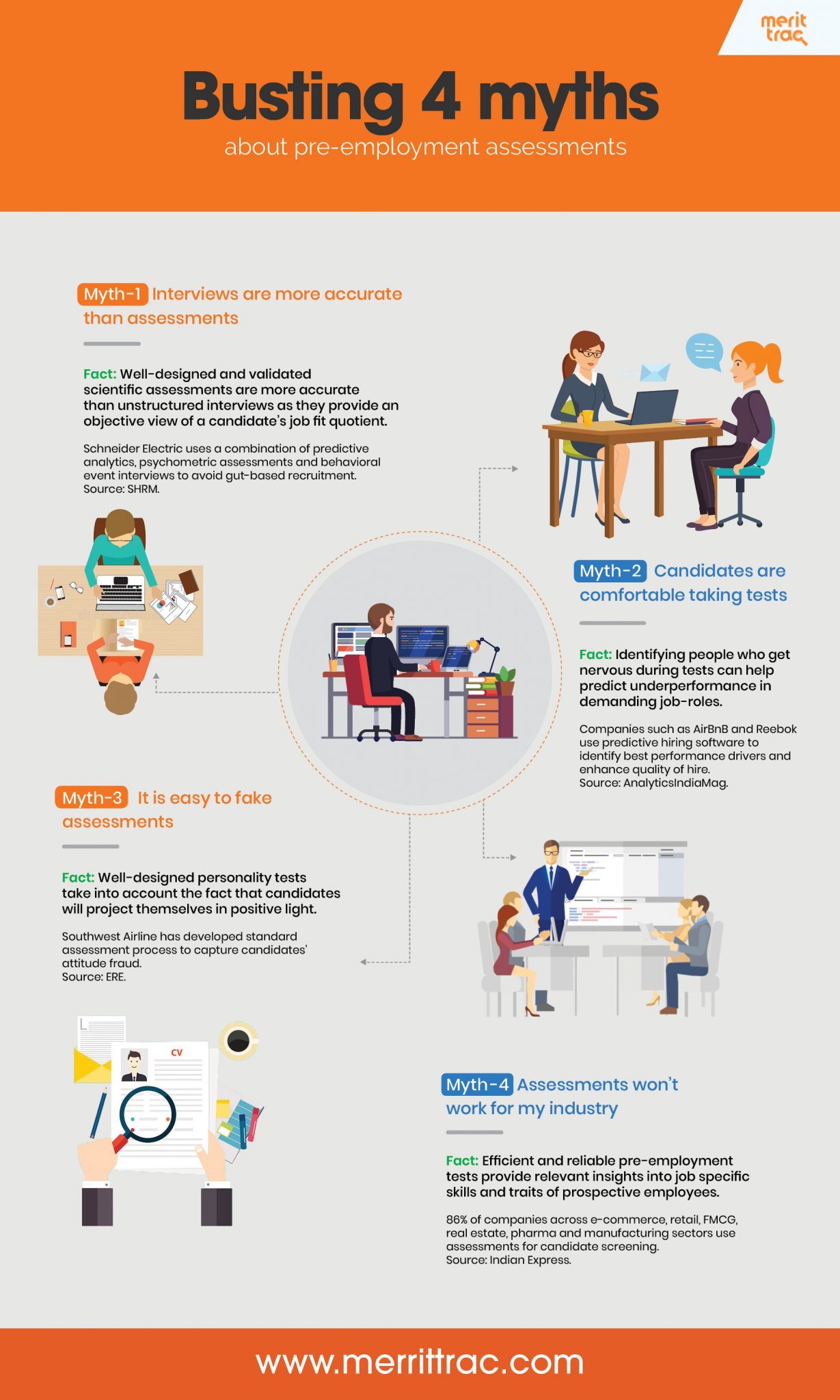
Traditional interview methods are time-consuming, and the hiring decisions are based more on judgment than on skill-related data of the candidates.
Also, it is often not just domain skills that need to be evaluated but even communication, behaviour, cognitive abilities, and other parameters. All these factors cannot be quickly and accurately understood just with a 30-minute interview.
Fact: Well-designed and validated scientific assessments are more accurate than unstructured interviews as they provide an objective view of a candidate’s job fit quotient.
Schneider Electric uses a combination of predictive analytics, psychometric assessments, and behavioural event interviews to avoid gut-based recruitment.
This is an age-old myth that all job applicants are comfortable taking tests. Still, often, there are candidates who, in spite of having the right domain skills, do not have the confidence or communication skills that are equally important for the job role.
Fact: Identifying people who get nervous during tests can help predict underperformance in demanding job-roles. Companies such as Airbnb and Reebok use predictive hiring software to identify best performance drivers and enhance the quality of hire.
The MCQs featured in pen, and paper-based tests often feature repetitive questions. This predictability factor, especially when it comes to assessing behaviour and personality, leaves the recruiter with less than optimal results.
No “one-test-suits-all”, this is where domain-specific assessments with questions curated by psychometricians and statisticians can give you personalized test results
Fact: Well-designed personality tests take into account the fact that candidates will project themselves in a positive light.
Southwest Airlines has developed a standard assessment process to capture candidates’ attitude fraud.
The same set of aptitude or cognitive test questions doesn’t help to find the specific skills required for different job types. But with the right kind of pre-employment assessments with specific questions curated by subject matter experts, organizations across industries can easily find high potential candidates.
Fact: Efficient and reliable pre-employment testing provides relevant insights into job-specific skills and traits of prospective employees.
86% of companies across e-commerce, retail, FMCG, real estate, pharma, and manufacturing sectors use assessments for candidate screening.
Slowly more and more organizations are moving away from traditional recruitment methods and are switching to online assessments that give them accurate test results.
The primary area of concern for recruiters is how to cut down on the time and cost involved in the recruitment process.
This is where online assessments help you by letting you focus on a variety of parameters and finalizes if a candidate’s domain skills, cognitive ability, communication skills, and personality are the right match.
Online assessments not only save time, effort, and money, but most importantly, it reduces the chance of mis-hires.
Pre-employment assessments offered by MeritTrac features 350 plus domain tests that can also be combined with aptitude, personality, or communication assessments to quickly rule out candidates who do not possess the required skills for the job role.
Source: SHRM, Indian Express, ERE, AnalyticsIndiaMag.