Key Takeaways
- Upskilling means training an employee in advanced capabilities within their current role; reskilling means training an employee in a new skill set to move into a different role.
- According to research cited in the blog, 16.2 million workers in India will need to reskill or upskill in AI and automation-related capabilities, while the same shift creates 4.7 million new tech roles.
- Only 10-25% of roles in Indian companies are currently filled internally, with the majority still going to external hiring.
- A reskilling strategy should follow four steps: skill-gap mapping, personalized learning paths, certification-based validation, and outcome tracking against business metrics.
- Assessment platforms like MeritTrac support reskilling through three core functions: skill audits, competency mapping, and certification validation.
A skill that felt future-proof two years ago may already be outdated today. That is the pace at which AI, automation, and India’s booming GCC ecosystem are reshaping job roles across sectors, from BFSI to core IT functions.
For enterprise TA leads and HR managers, this isn’t a distant trend to monitor. It’s a present-day operating challenge. Hiring externally for every emerging skill gap is slow, expensive, and increasingly unsustainable, while employees are actively looking for organizations that invest in their growth.
2026 marks a turning point. AI adoption is moving from pilot projects to core business functions, GCCs are scaling up specialised hiring, and government-backed skilling initiatives are reshaping the national talent pipeline, all at the same time.
This blog breaks down what reskilling and upskilling actually mean, why they matter now more than ever, and how organizations can build a strategy grounded in real skill data rather than assumptions.
Reskilling vs Upskilling: Meaning and Key Differences
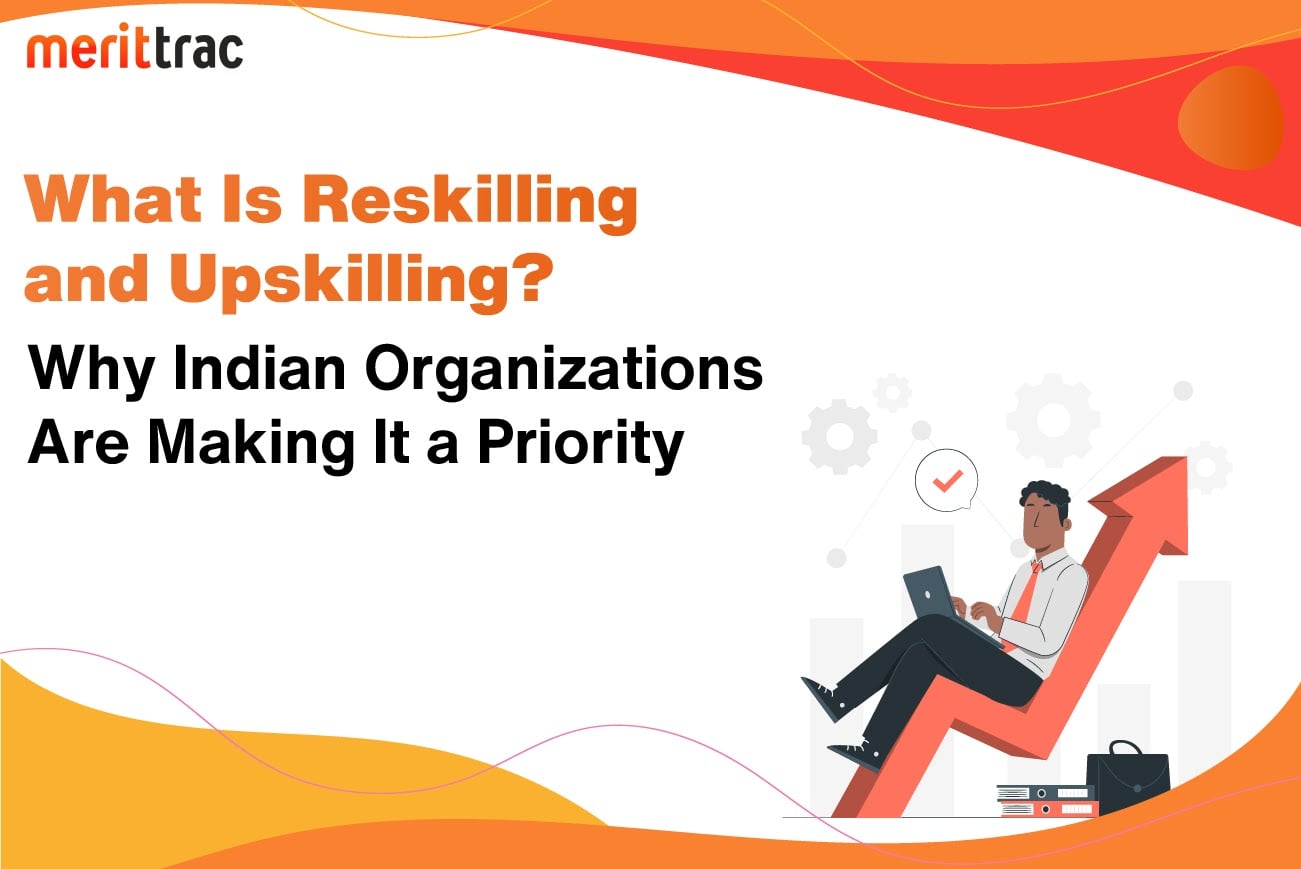
The two terms are often used interchangeably, but they mean different things for workforce planning.
- Upskilling meaning: Teaching an employee new, advanced capabilities within their current job function. For example, a data analyst learning Python automation to do their existing role more effectively.
- Reskilling meaning: Training an employee in a completely different skill set so they can move into a new role, often because their original job is shrinking or changing shape.
Put simply, upskilling goes deeper into a role. Reskilling moves sideways into a new one.
For TA and HR leads, this distinction shapes very different decisions. Upskilling supports promotion pipelines and productivity within existing teams. Reskilling supports redeployment and helps prevent layoffs when a function becomes automated or obsolete.
Both are becoming operational necessities. According to research, 16.2 million workers in India will need to reskill or upskill in AI and automation-related capabilities, even as the same shift creates 4.7 million new tech roles.
For enterprises, knowing which one a role needs is the first step to building the right talent strategy.
Why 2026 Is a Turning Point for Indian Organizations
India’s talent landscape is shifting faster than most L&D calendars can keep pace with.
On the technology front, AI and automation are no longer pilot projects. They are embedded into core operations across BFSI, IT, retail, and manufacturing, changing how roles are defined day to day.
Retention adds another layer of urgency. When employees don’t see a path to grow within their current organization, they look outside for it. Reskilling, in this context, isn’t a training checkbox; it’s a mechanism to keep critical talent from walking out the door.
Business Case: What is at Stake for TA and HR Leaders
For most Indian organizations, hiring externally is still the default. Only 10-25% of roles in Indian companies are currently filled internally, with the rest going out to the open market. That default carries a cost. External hires typically mean longer time-to-fill, higher recruitment spend, and a slower ramp-up to full productivity compared to internal moves.
There is also a brand dimension to this. Organizations known for investing in employee growth tend to attract stronger applicant pools, since career development is one of the first things candidates evaluate before accepting an offer.
On the productivity side, employees who move into new roles internally already understand company processes, systems, and stakeholders, reducing the learning curve that external hires typically go through in their first few months.
Key Drivers Pushing Reskilling & Upskilling in India
Several forces are converging at once, and no single one explains the shift on its own.
| Drivers | What is Changing | Why it Matters |
| Digital Transformation & AI Integration | AI is moving from pilot projects to core operations across IT, BFSI, retail, and manufacturing | Roles are being redefined faster than job descriptions can keep up, demanding continuous skill updates |
| Government & Industry Initiatives | Skill India and programmes like SOAR are building a structured national skilling pipeline | Creates external talent pools organizations can tap into, while raising the baseline skill expectations for new hires |
| Changing Employee Expectations | Employees increasingly prioritise visible career growth over static roles | Reskilling becomes a retention tool; employees who don’t see growth opportunities look elsewhere |
| Compliance & Role Redefinition | Regulated sectors (BFSI, healthcare, manufacturing) face evolving standards alongside new technology adoption | Existing roles must be redefined and re-certified rather than simply replaced, making structured upskilling non-negotiable |
Together, these four drivers are pushing reskilling from an HR initiative to a board-level priority.
How Organizations Can Build a Reskilling or Upskilling Strategy
A strategy works only when it starts with data.
Step 1: Map the gap before you plan the training.
Before designing any programme, organizations need clarity on where the actual gaps lie, role by role, team by team. This is where structured skill-gap assessments matter. Platforms like MeritTrac help enterprises benchmark current employee capabilities against role requirements, giving TA and HR teams a clear, evidence-based starting point instead of assumptions.
Step 2: Personalize the learning path.
A single training module rarely fits an entire department. Once gaps are mapped, learning paths should be built around the specific skills each employee or employee segment actually needs, rather than generic upskilling content rolled out uniformly.
Step 3: Validate the learning, don’t just deliver it.
Training without validation leaves a blind spot. Structured assessments and certifications confirm whether a skill has actually been acquired, giving both the employee and the organization a verifiable marker of progress, something a completion certificate alone doesn’t guarantee.
Step 4: Track outcomes against business metrics.
ROI shouldn’t be measured by course completions. It should tie back to role readiness, internal mobility rates, and productivity shifts post-training. Without this loop, reskilling stays a cost centre instead of becoming a measurable business input.
Organizations that treat assessment as the starting and ending point of their strategy, not just a training add-on, are better positioned to make reskilling decisions that hold up under scrutiny from finance and leadership alike.
Where Assessment Platforms Fit Into the Strategy
Reskilling programs are only as strong as the data behind them. This is where assessment platforms play an enabling role.
MeritTrac supports enterprises across this process in three ways:
- Skill audits: Evaluating existing workforce capabilities against current and future role requirements, replacing guesswork with measurable data.
- Competency mapping: Identifying exactly where gaps exist, at individual, team, or organization-wide levels, so training spend is targeted rather than generic.
- Certification validation: Confirming that a skill has genuinely been acquired post-training, giving HR and business leaders a verifiable outcome rather than a completion checkbox.
For TA and HR leaders managing reskilling at scale, this structured approach removes ambiguity from an otherwise subjective process. Instead of relying on self-reported skill levels or manager assumptions, decisions get grounded in assessment data.
If your organization is building or refining its reskilling strategy, exploring how MeritTrac’s assessment solutions fit into that process is a practical next step.
MeritTrac helps enterprises replace guesswork with data, running skill audits, mapping competency gaps, and validating certifications so reskilling decisions are grounded in evidence. This gives TA and HR leaders a clear, measurable way to track whether training investments are actually closing the gaps that matter.
CTA: Ready to build a reskilling strategy backed by real assessment data? Explore MeritTrac’s solutions today.
Frequently Asked Questions (FAQs)
- What is the difference between reskilling and upskilling?
Upskilling trains an employee to go deeper into their current role. Reskilling trains an employee in a different skill set to move into a new role.
- Why are Indian organizations prioritizing reskilling and upskilling in 2026?
AI adoption, GCC expansion, and government-backed skilling initiatives are converging at the same time, changing job roles faster than traditional hiring or training cycles can keep up with.
- Is internal mobility more cost-effective than external hiring in India?
Only 10–25% of roles in Indian companies are currently filled internally. External hires typically involve longer time-to-fill and a slower ramp-up to full productivity compared to internal moves.
- How can organizations identify which employees need reskilling versus upskilling?
A structured skill-gap assessment, benchmarking current employee capabilities against role requirements, is the first step. Platforms like MeritTrac support this through skill audits and competency mapping.
5. How is the success of a reskilling program measured?
Effective measurement ties back to role readiness, internal mobility rates, and productivity shifts post-training, not just training or course completion rates.